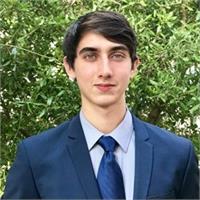
 The International Society of Automation’s (ISA)Power Industry Division selected Daniel Joshua “Joshua” Barron, a Junior double major in Computer and Electrical Engineering at the University of Texas at San Antonio, graduating in May, 2022, as the recipient of the USD $4000 Robert Hubby Scholarship Award. Joshua also received the 2021 Educational Foundation Scholarship Award in the amount of USD $2,000.
Joshua says; “I am very close with my family. My Mom, Gina, who inspired me to pursue an engineering degree graduated with an engineering degree from Auburn University, that's also where she met my Dad, Daniel. The same year I was born my Dad bought a 1973 Dodge Charger, which means that I grew up working on that car with my Dad. The many hours I spent with my dad fixing that car taught me many useful skills like soldering and how to rebuild a carburetor. I have a younger brother, Isaiah, who is also at UTSA where he is studying Civil Engineering. I have other younger siblings, Joseph, Rebekah, & Catherine that think I can fix any of the electronics they break just because I’m an Electrical Engineer. The truth is I just turn it off and back on again.” Joshua’s other passion is rock climbing/rappelling; as attested by the picture of him (below) at Matacanes Canyon near Monterrey, Nuevo Léon.
He goes on to say: “I had 248 total Hours of Volunteering over the summer of 2018 as Caretaker for Instituto Nuevo Amanecer AB. From June 15th to July 25th I was in Mexico volunteering at my Tia’s (Dr. Fabiola Barrón) institution for children with cerebral palsy. I volunteered M-F 8 hours a day, helping the children with physical therapy, swimming, arts and crafts, music, and dancing. While I was helping the kids, the kids and the other volunteers were helping me learn Spanish. See the certificate of hours In my featured tab! This was a wonderful and life-changing volunteering experience I had when I was 19 years old. My responsibilities included doing arts and crafts with the kids, playing guitar, piano, and singing for the kids while ensuring the improvement of their motor skills through art and swim therapy. With each leap in progress they made I joined in their celebration with juggling and dancing.
When asked why you are interested in the selected industry(ies) above, Joshua says: “I am interested in any industry where I can combine my passion for hardware with my experience in software. I am interested in 'Automatic Controls and Robotics' and 'Automation Project Management & Delivery' because these things are what I have the most experience with and already know that I would love a career in these fields. In high school, I lead two robotics teams to 1st place, in college I joined the Robotics and Automation Society. My two current research projects in drones and solar tracking rely heavily on my automation skills. My passion and experience in automation landed me an Internship with Michelin at their automation facility this upcoming summer. I am very interested in drones and can easily see myself working with Amazon on autonomous delivery drones or working on the next drone that we send to Mars. I am interested in the power industry because of my work with the solar panel research project. On top of doing all the automation algorithms for this project, I am also working on the goal of turning the power that's collected from the solar panels into a useful form that will allow the project to power itself and provide excess power that can be stored and used by the students. In learning how to achieve this goal I have learned a lot about power and find it very interesting. Lastly, I am interested in Smart Manufacturing & IIoT because it is a fascinating new field that has a way to improve peoples day to day life. A fun project that I took on outside of school was to turn a Raspberry Pi into an Alexa and I succeeded. I was able to check the weather and my calendar using just my voice. I'm interested in all technology that improves lives.”
When asked what have you achieved and learned through your studies/activities that makes you stand out? He says What makes me stand out is all the experience I have gained ever since I taught myself Python during winter break of my freshman year. At the time I only knew the C programing language, but most of the internships and research opportunities that I was interested in required Python. My solution was to buy a raspberry pi kit and teach myself Python over the winter break. Once I learned Python I was able to secure a position in a research lab on campus working on a custom drone. That research went so well that I was able to continue that research for another 18 months with a grant from the National Science Foundation to add person detection to the drone I built for the purpose of turning it into an autonomous rescue drone. The research experience I gained from my drone research was a major factor in me obtaining an internship with the DoD summer of 2022. For this internship, I created an automated way to measure hand dexterity by writing code for the leap motion hand sensor. During this internship, I vastly expanded my Python skills by learning how to use things like the pandas Python Data Analysis Library. The things I learned from the drone and DOD research projects have been carried with me into my current research project on dual-axis suntracking solar panel array using a pneumatic system. This current research is my favorite yet because it lets me combine my passion for software, Machine Learning, hardware, and power, into a project that is for the benefit of the environment and society. All of these wonderful and unique experiences all stem from the decision that I made to teach myself python back in winter break of freshman year. This is why I stand out.
Describe your future plans in instrumentation, systems, or automation. Joshua goes on to say; I have a strong passion for research and development, because of this, I plan on getting my master's in electrical engineering after my undergraduate. That is if I can complete my undergraduate without a substantial amount of student loans. Regardless of if I get to pursue graduate school or not, I plan on using my experience with automation, controls, systems, and renewable energy to secure a career in the electrical engineering field. I currently love my research with CPS energy on a dual-axis sun-tracking solar panel array using a pneumatic system. For this project, I developed Calibration, Search, and Control Algorithms into an Integrated system for tracking the sun from a database. I spent this past winter break writing a paper on the work I have done for this project and it is currently under review. In this project I also work with taking power from the solar panels, transporting, storing, and converting it into usable power that sustains the system. My passion for this project has only confirmed my belief that I want a career in automation or power, preferably a combination of both. I see myself possibly working on the next rover or drone to go a celestial body, or implementing Machine Learning and automation into the power grid or into other renewable energy projects. I accepted an internship with Michelin tires in their automation facility this summer and am ecstatic to gain more experience in automation. Luckily my passion for learning and electronics will let me excel wherever I do end up in the automation field.
When asked what do you think the industry of automation will be like in the next 10 years? Joshau goes on to say; I definitely see the industry of automation growing substantially in the next ten years. As a Research Assistant, I firmly believe the best way to tell what the next ten years will look like is by looking at what research is being funded today. With more than 18 months of drone research, I see the potential that drones have in package delivery, surveillance, and rescue missions. NASA just landed the Perseverance rover and an autonomous drone on mars. If one looks into the collective billions of dollars being spent in autonomous driving research by universities and companies like Tesla and GM it is clear it will be a major factor in the next ten years. By 2031 we could easily see the carriers of the truck, taxi, and Uber driver be replaced by autonomous self-driving vehicles. I especially believe in the development of the technologies that are behind these autonomous technologies like Lidar and Machine Learning. Lidar is on the newest IPad pro and iPhone, it's a major piece in most autonomous vehicles, and Researchers have already begun placing it on drones. As the price of Lidar comes down it will have a significant adoption in autonomous products over the next ten years. The final key is AI and Machine Learning which is currently receiving massive research funding and has one of the highest demands in the job market currently. This demand will result in Machine Learning being a major part of the next ten years, especially as it becomes easier to implement into products and software solutions. The beginning of this can be seen in how Apple, Samsung, Qualcomm, and Nvidia are currently including AI accelerators in their chips. Machine Learning implementations are limited to imagination, I even used it in my Solar Panel Project to improve tracking accuracy.